Showing posts with label Baja GAR. Show all posts

Friday, February 19, 2016

Booda Bill's GAR Journal #1 Post

Recently I was closing the Gar’s entrance gate and gazed at four mountain ranges surrounding me and entered a deep state of peace, compassion and well-being. Living up at the Baja California retreat center for over a month now, I am in this View each time upon entering the land, as each interaction becomes important, each person a daka or dakini, and all the flora and fauna my spiritual teacher.

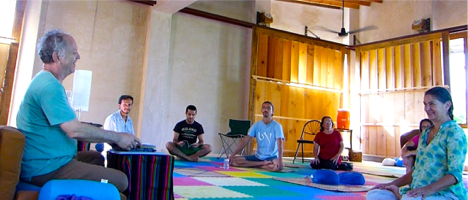
If I need more inspiration to get into this mood, there are always people around to practice a Tun, Ganapuja, Green Tara or a Vajra Dance. Recently I have been practicing early in the day and this sets an atmosphere for all activities and experiences. There have been a couple staying from the Czech Republic and the Gekyl, who is also “checo”, and we talk in a bunch of languages, mostly Spanish and English.

In a typical day, a non-dualistic, blissful perception seems to organically enter into many activities, especially when I’m working with Nature. My daily routine includes mindfully checking the gardens, looking for insects, signs of growth, areas needed inout. Everyday some new growth appears or a baby seed pokes through the ground proving once again that space, earth and joy can be inseparable. Hundreds of seeds, seedlings and new plants all need attention and love so that they may in return benefit and bless you with their beauty and healthy benefits. One of my favorite things to grow, the orange-root Turmeric, has over 600 medicinal benefits. No wonder the lama’s robes are orange!

Along with the dharma study and practice, I have been training with permaculture teachers who work synergistically with the local landscape. Three workshops are taking place this year and I enjoy being able to live in a place where I can think, work, live and eat in the most healthy ways possible.

After several hours of work, it’s off to the outdoor kitchen where members often gather and talk, catch up and discuss current events and projects. More work is followed by a nature walk, saxophone practice, and then dinner.


A typical night at the Gar has zero light and noise pollution so stars, planets and meteor showers become a vivid, peaceful experience. With no street noise within 10 miles, I only hear our mountain stream and the gentle tinkle of bells around far away goats and cows. It’s a well accepted fact that everyone’s dreams become deeper and more profound on this land. Occasionally, Nature appears in the form of a Buddha like the hummingbird that was resting in front of my casita and wouldn’t let me open the door.

Waking up early as a naturalist has been my best strategy, although I carry the camera with me all day: you never know when an amazing insect, passing hawk or desert hare might appear. Paradoxically, looking for birds yields less birds. I find it better to walk up to one of the many stone terraces and meditate upon the spectacular view of the Cape Mountains and Lowlands. Inevitably, a bundle of feathery beauty will emanate out of the thickets and scrubs to  look at me. As I am blessed by their beauty, gratefully receiving them as a blessing.

One challenge has been dealing with the wild pigs coming to destroy months of hard work preparing garden beds in the Cape Mountain jungle. The pigs are thriving, like everything else, activated by the extra rains from the last two years. After many primal emotions had arisen and dissolved, I found it best to create 2-3 feet of spiny Mesquite branch barriers around all access points. So far this has worked and my frustration has been transformed into equanimity.

The Gar includes 3,000 acres, south of a UNESCO world heritage site calle Sierra la Laguna, a biosphere with 15% endemic plants. There are many species of animals also that only call this area home, and combined with the UNESCO protected coral reefs, makes this the “Galapagos Islands” of Mexico. These are not the dry mountains of past years. This jungle requires months of cutting, trimming and hauling out to clear the amazing hiking trails, many lined with stone walls adding a sense of permanence to the ever changing mountains.

For personal retreat and practice, the surrounding landscape, mountains and ambience helps me expand into Nature’s benevolence, abundance and power. There is so much peace and stillness here, followed by much movement and activity where the stillness can remain.


Inspiration and dharma reminders infuse the retreat center atmosphere and especially during and after retreats. When Steve Landsberg recently taught, we were deeply inspired and took the practices to the hot springs where we soaked in natural mineral waters, swam in cool mountains waters and generally blissed out. The practice and study accumulates, and after each week I enter more deeply into clarity, wisdom, compassion and seem to have a bit more integration.


Vajra Dance Mandala

Friday, January 16, 2015

Vajra Dance Course in Todos Santos BCS

Please join us for two great weekends learning Vajra Dance
with Anya Neyman and let people know who may be interested...
If you would like to see a demonstration dance come Fridays
to CUATRO VIENTOS at 10:30am by La Esquina, Todos Santos.
 All welcome!  (Download info en Español bajo esta)
(download flyer to share)
Weekend Workshops Schedule:
Friday 6pm-9pm, Saturday and Sunday 12pm - 7pm 
with a break for lunch and shorter breaks in the afternoon.
Suggested donation is 1,000 pesos for the five sessions,
with arrangements available for those with financial limitations.


THE DANCE OF THE VAJRA THAT BENEFITS BEINGS

In the Dzogchen teaching, Vajra means our real nature, the true condition of all phenomena. The Dance of the Vajra is an important method that uses sound and movement as a means to integrate the three aspects of our existence – body, speech and mind – in the knowledge of our real nature.
The Dance of the Vajra is a cycle of dances forming a special and effective practice for restoring and purifying the natural state of our whole being, allowing us to evolve to our real potential and naturally develop clarity and compassion toward ourselves and others. It benefits and rejuvenates us by harmonizing our physical, mental, and emotional condition.

Twelve practitioners, six females and six males, dance together on a large Mandala of five colors, representing the correspondence between the internal dimension of the individual and the outer dimension of the world. The slow, coordinated movements as we softly sing and practice awareness together produce an experience of deep relaxation and a calm state of mind and help us integrate with the circumstances of the outer environment.

In the Dance of the Vajra That Benefits Beings, the dancers are accompanied by the music and chanted syllables of the Mantra of the Six Spaces of Samantabhadra, the primordial Buddha, symbolizing our real nature.
The Dance of the Vajra That Benefits Beings can be practiced by anyone who wishes, and as long as its origin and integrity are always acknowledged and respected it can be used as a method to enrich any spiritual path.

Chögyal Namkhai Norbu is a renowned scholar and is widely acknowledged to be a great living master of Dzogchen, the essence of Tibetan Buddhism. He first introduced the Dance of the Vajra to his students in 1990. It is now practiced in various places and centers of the Dzogchen Community all around the world.

“The Dzogchen Teaching is not a philosophy,
or a religious doctrine, or a cultural tradition. 

Understanding the message of the 
Teachings means discovering one’s own true condition, 
stripped of all the self-deceptions and falsifications that the mind creates.”
~ Chögyal Namkhai Norbu

The Dance of the Vajra is associated with the
 International Dance Council,
CID UNESCO.


Tuesday, January 24, 2012

Tibetan Buddhist Retreat Center


Baja Ca Sur has a Dharma Center named Tsegyalgar West situated on Los Naranjos Road in the San Jose Mountains. The beautiful ranch was given to the International Dzogchen Community, under the direction of Chogyal Namkhai Norbu Rinpoche in 2003. Since then he and his senior students have been giving teachings such as Yoga Yantra, the sacred Dance of the Vajra, various tantric practices such as Mandarava, Chod, Ganapuja and practices of Dzogchen which are pure awareness practices.

Dzogchen teachings are also known as Ati-yoga, or Primordial Yoga. The word yoga is used as the equivalent Tibetan term naljor, which means awareness of the authentic condition of each individual at the core (without layers of ego). Dzogchen teachings have been transmitted through the culture of Tibet. Now in recent years they have spread around the world.

Tsegyalgar West, in the San Jose Mountains is a rustic retreat center. This beautiful and wild 3,000 acre land has natural springs, granite boulders, grand vistas and deep quiet for retreat. 
There are 12 casitas available for sleeping and camping bathhouses as well. The mission is to preserve the Dzogchen Tibetan Buddhist teachings and preserve a very special and natural environment for spiritual practice. 
This year Tsegyalgar west invites everyone interested to special retreats, practices and introductory talks.  There will be several retreats on the retreat land from February to May 2012. Public introductory talks will be held in Todos Santos with each visiting teacher. Please see schedule of events or the web site www.tsegyalgarwest.org for more information.

Tashi Delek! Auspicious wishes!

Tsegyalgar West, San Jose del Cabo Mountains, BCS   Please contact for more information:  tsegyalgarwestsecretary@gmail.com